


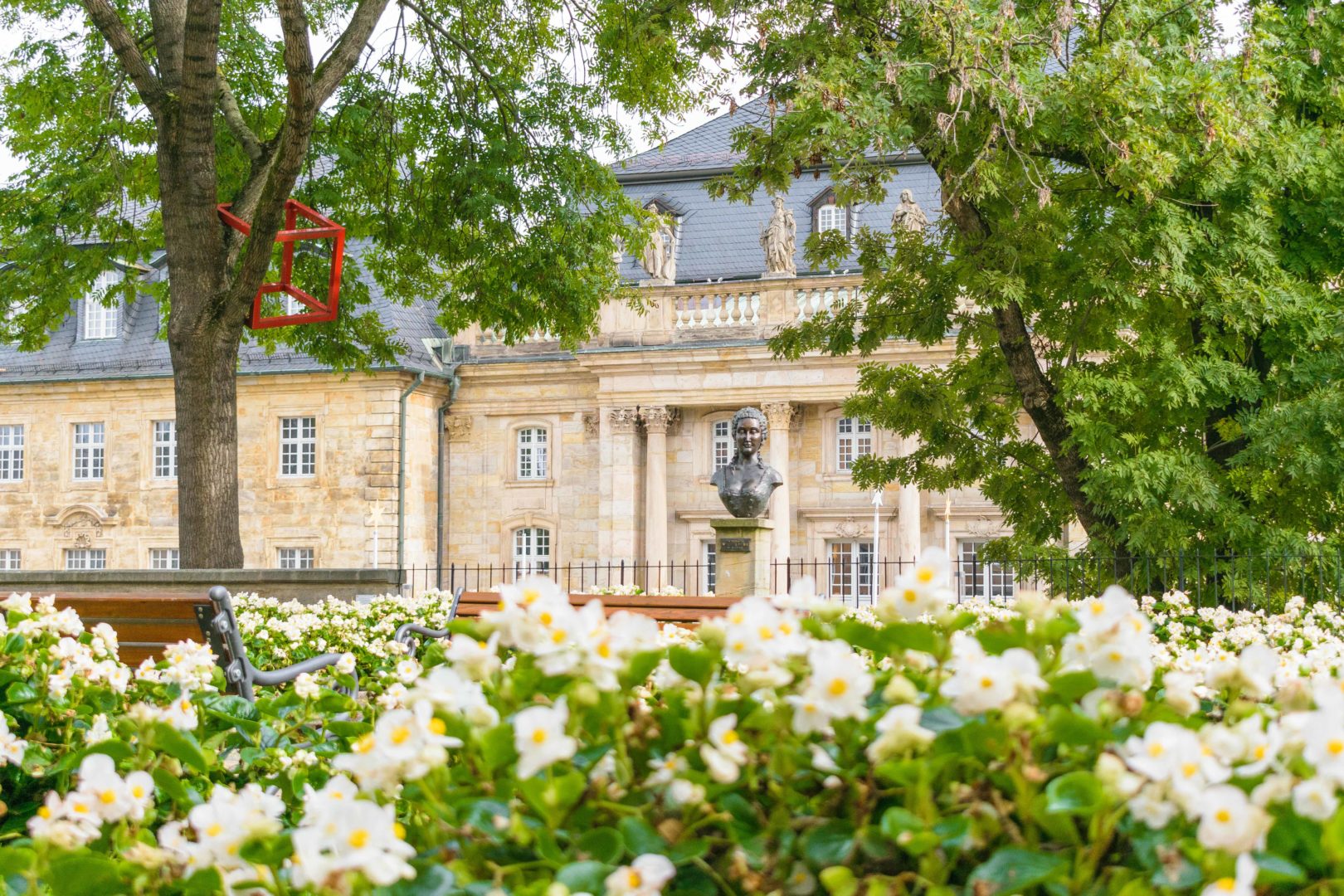
The Mariengärtlein (Little Garden of Mary) at the Schlosskirche has become a well-known insider tip for peace and relaxation.
The location of the Mariengärtlein
It lies in the middle of the city in the historic margravial surroundings of the Altes Schloss (Old Palace). The former court church was built in the mid-18th century, after the palace fire, as a typical Margrave church and was given to the city’s Catholics in 1812. Since 1959, the altar of what is now the Catholic Schlosskirche “Unsere Liebe Frau” (Our Lady) has been adorned with a Baroque Madonna with grapes from wine-growing Franconia – and that in beer-loving Franconia! Directly adjoining the church is the former residence of the margravial court architect Carl Christian von Gontard, which today serves as the parish house. Directly opposite stand the former Margravial Redoutenhaus and the Margravial Opera House, a World Heritage Site since 2012. The Mariengärtlein enjoys a privileged location within the old margravial court district inside the city wall.
Created as a place for reflection
The Mariengärtlein at the Schlosskirche has existed since the 2016 Bavarian State Garden Show. At that time, a cycle route through the city centre with various stations for reflection was planned, and one such stop was to be created at the Schlosskirche. The concrete roundel with a small fountain already existed before 2016 and was to be given a new “face”.
The idea of creating a Mariengärtlein came about at the Garden Art Museum at Fantaisie Palace in nearby Donndorf. There, as a model for the medieval garden, hangs a print of the small panel painting “The Little Garden of Paradise“, painted around 1410/20 by the Upper Rhenish Master and now held in the Städel in Frankfurt. It was created at a time when art served to honour God and to lead people, many of whom could not read, to Him. The small format was intended for private contemplation, for devout immersion – for meditation. Plants, animals, colours and numbers had a meaning, a symbolism that these people understood. They could read pictures, though often not letters. The biblical stories and the legends of the saints were well known. The small painting shows many plants that can be symbolically associated with the Mother of God and are at the same time medicinal plants. They are painted in a botanically realistic way, so they can be identified.
Mehr erfahrenIn Oberfranken liegt das größte geschlossene Süßkirschenanbaugebiet Mitteleuropas. Diese Streuobstwiesen liefern den Rohstoff für knapp 300 Schnapsbrennereien.
The little oasis in the city centre
The city parks department planted many of these Marian flowers and, thankfully, still looks after them today. Depending on the season, roses with and without thorns, Madonna lilies, milk thistles, violets, strawberries, daisies, lilies of the valley, columbines and irises are in bloom. Trees such as cherry, fig, pomegranate and olive not only give the whole garden visual height, they also blossom and bear fruit. Very old and described in many ancient traditions, they are known as trees of paradise. The small fountain in the centre can be interpreted as the fons vitae, the fountain of life. Complementing the Madonna with grapes in the Schlosskirche, a vine with blue grapes climbs up one wall.
On Marian feast days there are guided tours featuring more or less well-known works of art on the symbolism of the plants in bloom at the time and on the respective feast day.
A flyer with the current dates is available at the Mariengärtlein and at the Tourist Information.


