



The region is famous for its sausage specialities, such as Bayreuth bratwurst in a bread roll or Saure Zipfel (sausages cooked in a vinegar broth). Sunday is also roast day, with dumplings and cabbage. Why not cook these Franconian delicacies yourself with the help of our recipes?
A Franconian Sauerbraten (marinated pot roast) or a traditional Schäufele often turns an ordinary day into a perfect one. Of course, hearty platters of sausage and cheese, sausage salad and brawn are also part of a proper Brotzeit (Franconian snack). It is rounded off with one of the many varieties of bread or with aniseed pretzels. Franconian cuisine also has plenty to offer those with a sweet tooth – from Küchla doughnuts to piped butter biscuits, there is all sorts to taste.

Bayreuther Schäufele
Schäufele (roast pork shoulder) is one of the classics of Bayreuth and Franconian cuisine and has always been hugely popular. Traditionally, this delicious, tender yet crispy roast is served with dumplings and sauerkraut or salad.
Image (c) Genussregion Oberfranken
Ingredients for 4 people:
- 1 1/2 kg Schäufele (pork shoulder with bone and rind)
- 1/2 l lightly hopped dark beer
- salt, pepper, caraway,
- a little marjoram
- a little olive oil for searing (healthier than clarified butter),
- one clove of garlic
- bay leaf
- root vegetables (onion, carrot, celeriac, parsley root)
- 1/2 l water
Method:
It is best to buy the meat from a butcher who will cut the Schäufele for you “Franconian style” from the flat shoulder of the pig, with bone and rind. After washing, dry the Schäufele thoroughly with kitchen paper, rub it with salt and pepper and sear it on all sides in a roasting pan, not over too high a heat. Gradually add the vegetables and spices and fry them briefly as well. Then deglaze with the dark beer and a little water. Now place the Schäufele, rind side up and covered, on the bottom shelf of the oven preheated to 160°, and roast it for about 3 hours in total. Remove the lid after about 2 1/2 hours, raise the temperature to 200° and baste the Schäufele several times with the juices during the last 30 minutes. The meat is done when it comes away from the bone very easily and the crackling is nice and crisp. Now take the meat out of the oven and set it aside briefly. Pass the juices through a sieve and thicken the sauce a little. To do this, you can either briefly blend the roasted vegetables (note: remove the bay leaf first) and return them to the sauce. Alternatively, thicken the sauce with cornflour or gravy granules and season it with salt and pepper to taste. Serve the Schäufele with the sauce, potato dumplings and sauerkraut or salad. To drink, we recommend a cool beer from one of the Bayreuth breweries. Bayreuth Marketing & Tourismus GmbH wishes you bon appétit!
Recipe by Frank Nicklas (BMTG)

Frängische Brotzeid (Franconian Brotzeit snack platter)
Image (c) Genussregion Oberfranken
Ingredients:
One slice each of red and white Presssack (brawn sausage), home-made brawn, farmhouse liver sausage, smoked meat, ham, a piece of Göttinger sausage, Bauernseufzer sausages, cold roast, G’rupfter (cheese spread) and a piece of Backstaakäs (brick cheese)
Radish slices, red radishes, silverskin onions, a quartered tomato, a gherkin and a lettuce leaf for garnish. A knob of butter is a must.
A Franconian Brotzeit always includes a hearty farmhouse loaf and a Seidla of beer.
From: Lesekochbuch Bayreuth by Birgit Ringlein (author)

Grautsbroodn (cabbage meatloaf)
Image (c) Birgit Ringlein
Ingredients:
- 500 g–1 kg white cabbage
- 750 g minced meat
- 250 g diced pork
- 4 Siedwürste (Franconian boiling sausages)
- 2–3 chopped onions
- 2–3 tbsp clarified butter
- 1–2 tbsp caraway
- marjoram or rosemary to taste
- 2–3 stale bread rolls, soaked in a little milk
- slices of smoked bacon as required
- salt, pepper
Method:
Remove the outer leaves from the cabbage, wash it, cut it into quarters, steam it in salted water and drain, then chop it very finely or put it through a mincer.
Meanwhile, fry the onions and the diced pork in clarified butter, then mix with the minced meat, the sausage meat squeezed out of the skins of the Siedwürste, the cabbage, the soaked bread rolls and the remaining flavourings, and season generously with marjoram, rosemary and pepper.
Put the meat mixture into a long roasting tin well greased with clarified butter and, if possible, cover it with slices of streaky bacon. Roast in the oven at 200°C, reduce the heat after 15 min and continue roasting at a medium heat for about 60 min.
Serve with boiled potatoes.
From: Lesekochbuch Bayreuth by Birgit Ringlein (author)
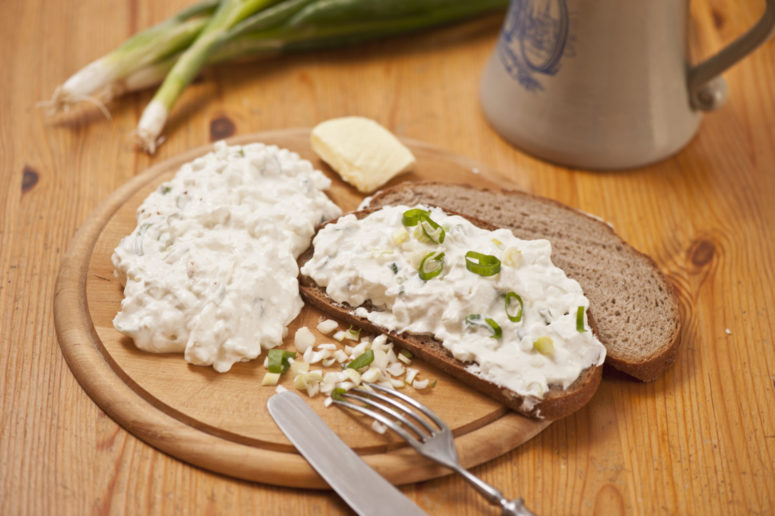
Ziebalaskäs (onion cheese spread) – a quick and easy recipe
Image (c) Genussregion Oberfranken
Ingredients:
- 200 g quark
- 100 g cottage cheese
- 1 small onion, finely diced
- 1 bunch of chives, finely chopped
- 80 ml cream
- salt to taste
Method:
Mix all the ingredients together.
Farmhouse bread and beer go well with it.
From: Bayreuther Lesekochbuch by Birgit Ringlein (author)

Friedlinde’s best Kerwaküchle – an old recipe
My mother Friedlinde came from a farming family; she was a real “Bauernmaadla” (farm girl) and
learned to bake Küchle from her mother and grandmother. Traditionally, the Küchle were of course
baked for the Kirchweih (church fair, “Kerwa”), hence the name – but naturally also for big family celebrations
such as weddings, christenings and confirmations.
And in large quantities, together with other Küchle bakers. On such occasions you need at least three of them – one pulls the Küchle into the fat, one fries them and one carries them away… The Küchle were then shared out among family, friends and neighbours. For my wedding in 1989, no fewer than 1,200 Küchle were baked at home in a single day!
My mother’s original recipe is designed for 3 kg of flour and can be scaled up or down as you like. For home use, 500 g of flour is enough; this makes about 15 pieces.
Ingredients:
- 500 g flour (German type 550)
- 85 ml milk
- 14 g fresh yeast
- 100 g sugar
- 1 tbsp vanilla sugar
- 100 g soft butter
- 12 g clarified butter
- 4 eggs
- 1 pinch of salt
- 2.5 sweetener tablets (dissolved)
- 40 ml arrack
- grated zest of one organic lemon
- plus clarified butter for frying and icing sugar for dusting
Method:
Put the flour into a bowl and make a well in the centre. Dissolve the yeast with a little sugar in some lukewarm milk, pour it into the well, stir in a little flour and make a “Dämpfla”, a small starter dough. Cover the bowl with a cloth and leave it in a warm place for about 20 minutes, or until the starter has visibly grown.
In the meantime, stir the eggs with the remaining sugar and the vanilla sugar and beat the eggs with a pinch of salt.
When the starter has risen well, add the remaining ingredients and work them into a smooth dough, slowly at first and then faster (dough hook). The dough is right when it comes away from the side of the bowl, has a nice sheen and ideally has no lumps.
Cover the bowl again and leave it in a warm place until the dough has visibly grown. Then cut off small portions of dough, shape them into balls and place them on a floured board. Leave the dough balls to rise again in a warm place for about 20 minutes.
Heat the fat in a large pan. When bubbles rise around a wooden spoon, it is hot enough.
The Küchle are now carefully “pulled out”, i.e. the dough is stretched by hand until it is about the size of a saucer. The edge must be thicker than the middle. This works best with oiled hands (melted clarified butter). Carefully place the pulled-out Küchle into the hot fat and fry them, floating, until light brown.
They taste best fresh and dusted with icing sugar.
Recipe by Doris Dannreuther
Birgit Ringlein trained both as a paralegal and as a foreign-language correspondent and worked for several years as a managing director in the USA and North Africa. In 2000, she returned to Bayreuth. Since 2011, she has been involved with the Genussregion Oberfranken and works as an author. Alongside her culinary crime novels, she has published numerous regional cookbooks.
The Genussregion Oberfranken has put together more recipes.

