






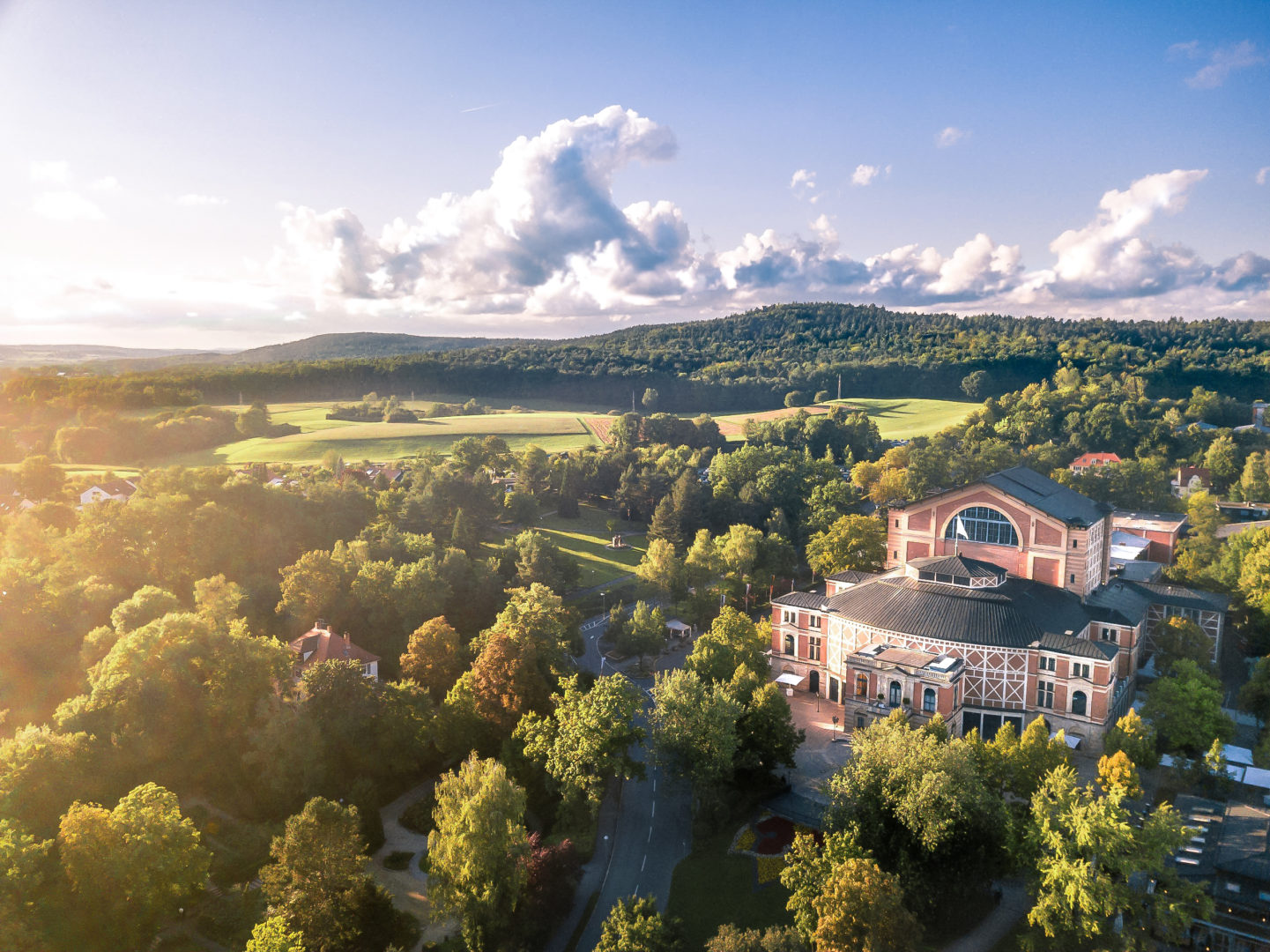
The Richard Wagner Festival, which has been held in Bayreuth since 1876, offers a unique presentation of Richard Wagner's works.
Every summer, Bayreuth is the cultural center of artistic exploration of Richard Wagner’s music. The festival takes place in the Richard Wagner Festival Hall, which can also be visited (but only outside of festival season) as part of a guided tour.
Inhaltsverzeichnis
- Outlook for the Festival Anniversary in 2026
- Program of the Bayreuth Festival 2026
- Festival Magazine 2026
- Video: The setting of the Bayreuth Festival
- The Bayreuth Festival – Facts and History
- The origins of the Bayreuth Festival
- Why in Bayreuth?
- The Festival Orchestra of the Richard Wagner Festival
- The Festival Choir of the Richard Wagner Festival
Outlook for the Festival Anniversary in 2026
In celebration of the 150th anniversary of the first festival in 1876, the city of Bayreuth is hosting a city-wide festival in 2026. Accompanying the anniversary festival in 2026 on the Green Hill, one hundred and fifty stages will be set up throughout the city and county. From January to December, the entire region showcases its cultural diversity with music, theater, and art that spans from Wagner’s work to the present day.
From the last 150 to the next 150 years – be there in 2026!
Program of the Bayreuth Festival 2026
- Friday, 24 July 2026, 8pm: Festspiel Open Air (Location: Festival Park)
- Saturday, 25 July 2026, 6pm: IX. Symphonie
- Sunday, 26 July 2026, 4pm: Rienzi
- Monday, 27 July 2026, 6pm: Das Rheingold (part of “Der Ring des Nibelungen”)
- Dienstag, 28 July 2026, 4pm: Die Walküre (part of “Der Ring des Nibelungen”)
- Wednesday, 29 July 2026, 6pm: Der fliegende Holländer
- Thursday, 30 July 2026, 4pm: Siegfried (part of “Der Ring des Nibelungen”)
- Friday, 31 July 2026, 4pm: Parsifal
- Saturday, 1 August 2026, 4pm: Götterdämmerung (part of “Der Ring des Nibelungen”)
- Sunday, 2 August 2026, 5pm: Festspiel Open Air (Location: Festspielpark)
- Sunday, 2 August 2026, 7:30pm: Brünnhilde brennt (Location: Friedrichsforum)
- Monday, 3 August 2026, 4pm: Rienzi
- Tuesday, 4 August 2026, 6pm: Das Rheingold (part of “Der Ring des Nibelungen”)
- Tuesday, 4 August 2026, 7:30pm: Brünnhilde brennt (Location: Friedrichsforum)
- Wednesday, 5 August 2026, 4pm: Die Walküre (part of “Der Ring des Nibelungen”)
- Thursday, 6 August 2026, 6pm: Der fliegende Holländer
- Thursday, 6 August 2026, 7:30pm: Brünnhilde brennt (Location: Friedrichsforum)
- Friday, 7 August 2026, 4pm: Siegfried (part of “Der Ring des Nibelungen”)
- Saturday, 8 August 2026, 4pm: Rienzi
- Sunday, 9 August 2026, 4pm: Götterdämmerung (part of “Der Ring des Nibelungen”)
- Monday, 10 August 2026, 4pm: Parsifal
- Wednesday, 12 August 2026, 6pm: Das Rheingold (part of “Der Ring des Nibelungen”)
- Thursday, 13 August 2026, 4pm: Die Walküre (part of “Der Ring des Nibelungen”)
- Friday, 14 August 2026, 4pm: Rienzi
- Saturday, 15 August 2026, 4pmr: Siegfried (part of “Der Ring des Nibelungen”)
- Sunday, 16 August 2026, 4pm: Götterdämmerung (part of “Der Ring des Nibelungen”)
- Monday, 17 August 2026, 4pm: Rienzi
- Tuesday, 18 August 2026, 6pm: Der fliegende Holländer
- Wednesday, 19 August 2026, 4pm: Rienzi
- Thursday, 20 August 2026, 4pm: Parsifal
- Saturday, 22 August 2026, 4pm: Rienzi
- Sunday, 23 August 2026, 6pm: Der fliegende Holländer
- Monday, 24 August 2026, 4pm: Rienzi
- Tuesday, 25 August 2026, 4pm: Parsifal
- Wednesday, 26 August 2026, 4pm: Rienzi
Festival Magazine 2026
Discover the preview of the 2026 festival season, compiled for you by Bayreuther Festspiele GmbH:
Video: The setting of the Bayreuth Festival
The Bayreuth Festival – Facts and History
The Richard Wagner Festival, along with the participating artists, has made the city internationally known.
When the fanfares signal the start of the Richard Wagner Festival, an international audience flocks to the Festspielhaus on the Green Hill.
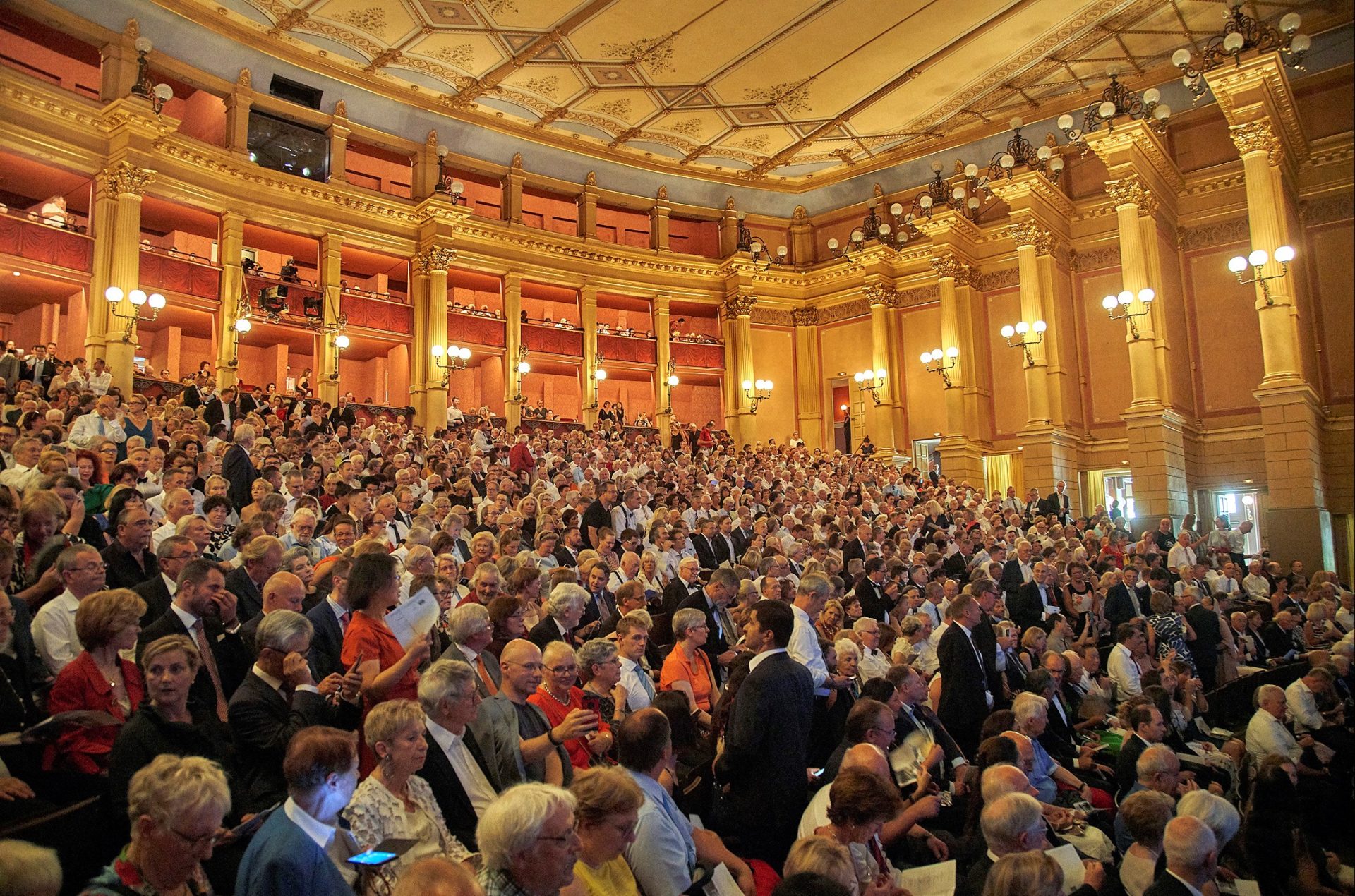
Thanks to the architectural design of the auditorium, the music unfolds here like in no other theater in the world. With their unparalleled acoustics, the Richard Wagner Festival draws approximately 58,000 visitors from around the world every year.
The Richard Wagner Festival begins annually on the 25th. July and last until the end of August. With a changing schedule each year, up to 30 performances are staged each season for approximately 2,000 spectators. A large portion of the guests come from abroad, particularly from France, Japan, and the USA.
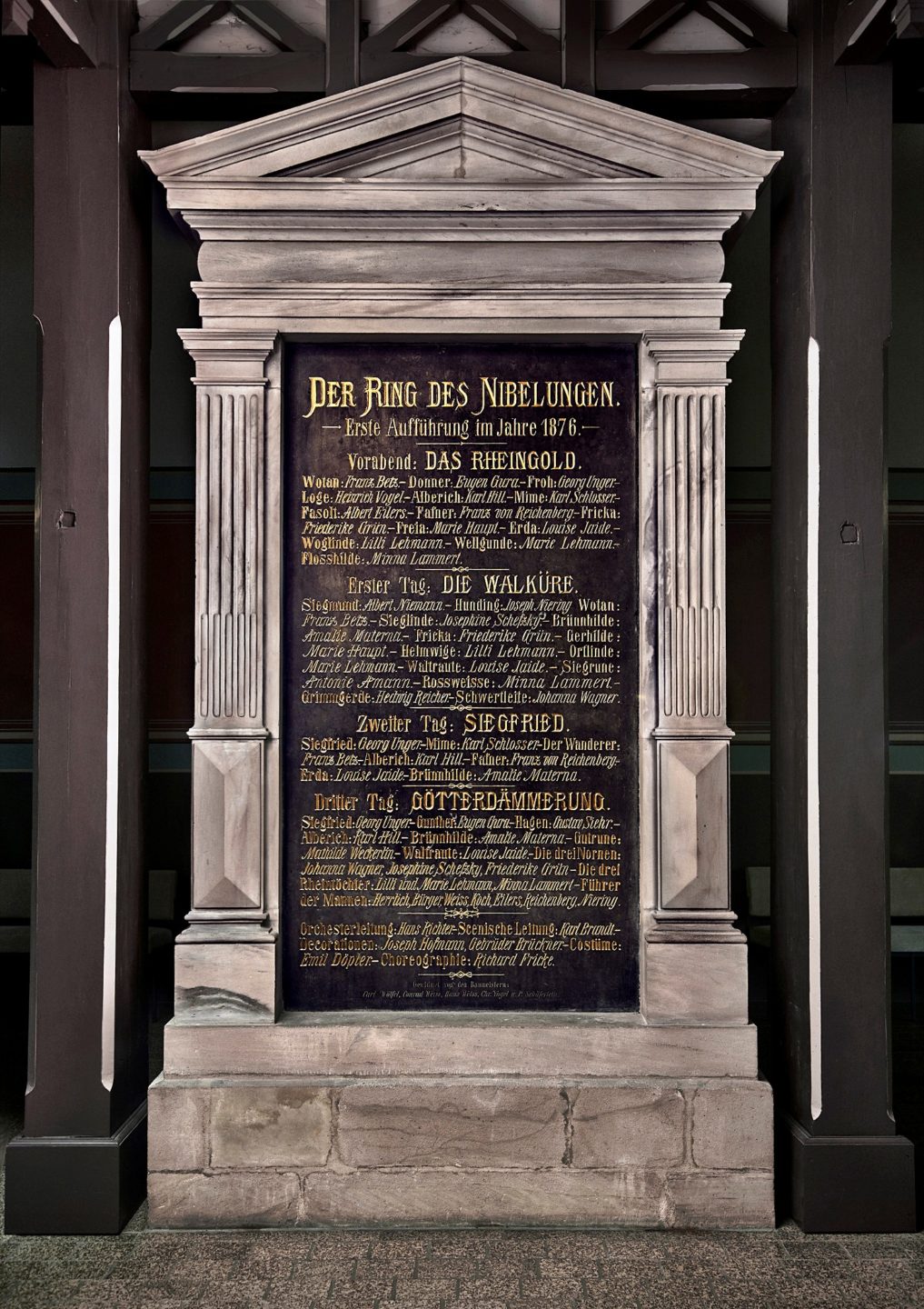
The operas performed at the festival house are: “Parsifal”, “Tannhäuser”, “Lohengrin”, “The Flying Dutchman”, and “Die Meistersinger of Nuremberg” as well as “The Ring of the Nibelung” with its individual works “The Rhine Gold”, “The Valkyrie”, “Siegfried”, and “Götterdämmerung”.
The origins of the Bayreuth Festival
The development of the festival idea and the creation of Wagner’s main work, “The Ring of the Nibelung,” were closely intertwined and mutually influenced. Both of these were rooted in his beginnings in the Vormärz, the time when Richard Wagner was the court kapellmeister in Dresden. Wagner’s thoughts on a fundamental theater reform eventually led him to the side of the revolutionaries of 1848/1849, and he actively participated in the Dresden May Uprising of 1849. After his downfall, he had to flee and escaped to Switzerland. In Dresden, he also created the draft for the Nibelungen drama “Siegfried’s Death”, which was incorporated into the later “Götterdämmerung”.
Why in Bayreuth?
Bayreuth was not Richard Wagner’s first choice at the time.
The composer considered building a festival hall in Zurich, Weimar, or Munich. After visiting the city and the then-abandoned Margravial Opera House, he decided to make Bayreuth his home.
However, the interior design of the opera house did not meet Wagner’s visual requirements. Therefore, he decided to build a festival hall according to his ideas on the Green Hill in Bayreuth. The foundation stone was laid in 1872.
After difficult years, money problems, and constant postponement of the opening date, the first Richard Wagner Festival took place in Bayreuth on 13 August 1876.
Life and work of Richard Wagner gave the former Upper Franconian residence city of Bayreuth a far-reaching, new radiance in the 19th century. The circle of music friends who want to experience the total work of art of the Richard Wagner Festival live has grown over the years. At the same time, the chance to get one of the very coveted tickets has become smaller. In the past, waiting times for a festival ticket of up to 10 years were not uncommon. Even today, the waiting time can extend to several months to years.
The Festival Orchestra of the Richard Wagner Festival
For the first Richard Wagner Festival, a specially assembled festival orchestra was brought together at Richard Wagner’s behest. On the occasion of the second Bayreuth Festival, the Bavarian King Ludwig II. Orchestra and choir of the Munich Court Theatre available. The Munich Court Opera Orchestra also played during the 1883 and 1884 festivals.
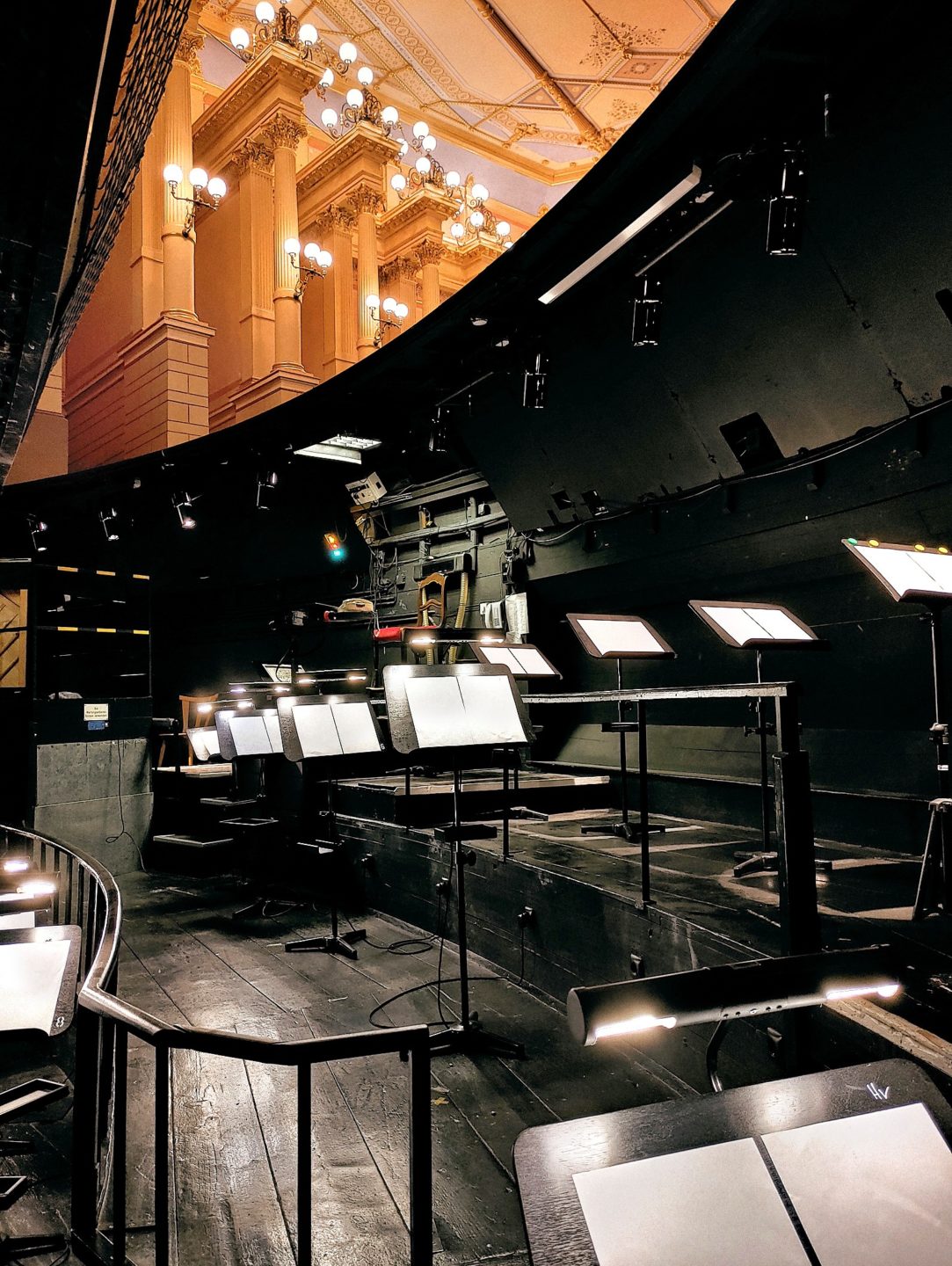
Since 1886, there has been a festival orchestra, composed of the best musicians from other ensembles. It has remained that way to this day: around 200 musicians from renowned orchestras in Germany and abroad come together specifically for the Richard Wagner Festival in Bayreuth.
Although the festival orchestra is hired anew every year, there are numerous musicians who have participated in the festival for many years. Depending on the work, up to 110 musicians come together in the orchestra pit. Many of them also consider the Richard Wagner Festival to be their second artistic home.
The Festival Choir of the Richard Wagner Festival
Today, the choir consists of members who come together exclusively for the weeks of rehearsals and performances in Bayreuth and choristers for augmentation. You don’t just have to shine in those choral parts that adorn every best-of-the-best opera choir recording today. The mass scenes have a character that carries the entire play and also require intense rehearsal work.
In years without “Ring” performances, the choir has a lot of work, as Rheingold, Walküre, and Siegfried are the only works in which Wagner completely omitted choruses. The vocal and stage requirements of the other main works are very different – aside from Tristan and Isolde, the chorus plays a key role in essential scenes in each of its operas and must manage enormous vocal requirements. The ladies and gentlemen are required to have great vocal flexibility – they must appear as martially aggressive companions of Hagen in Götterdämmerung, then lyrically glorified as pilgrims on the stage in Tannhäuser, and then again as Grail knights to shape Parsifal in multifaceted nuances.
A large portion of the singers come from professional choirs of European opera houses and broadcasting institutions, while others are not contractually bound to an institution but work as freelance singers, solo or in a choir, at various houses or in broadcasting choirs. Some students who are pursuing a singing career also gain experience with the Wagner repertoire in the Festival Choir. All contributors have previously undergone a selection process comparable to other professional choirs, led by the choir director, to qualify for the Bayreuth Festival Chorus.
The choir’s lineup changes every year. Their work is well-successful, as evidenced by the numerous prizes the choir has won, such as the ‘Orphée d’Or’ and the ‘Wilhelm-Pitz-Preis’. In 2014, the Bayreuth Festival Choir also received the International Opera Award 2014 in the category of best opera choir.
(Text sources: bayreuther-festspiele.de, bayreuth.de, Bayreuther Festspiele GmbH 2010: Festival idea, festival house, performances)